
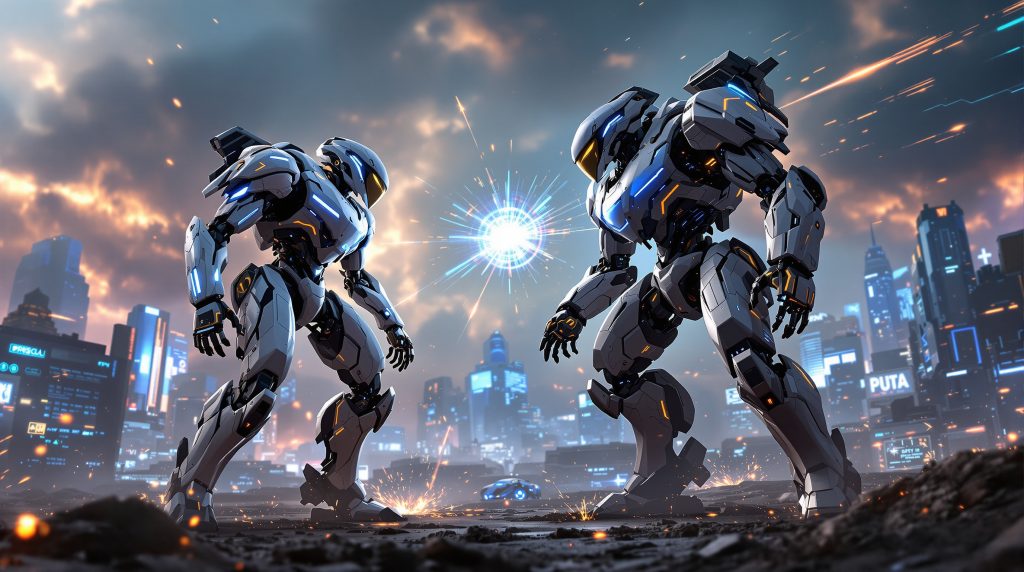
The race to develop practical humanoid robots has intensified dramatically in recent years, with two companies emerging as clear frontrunners in this revolutionary field. Tesla’s Optimus and Unitry’s G1 represent fundamentally different approaches to humanoid robotics, each offering unique advantages that could shape the future of automated labor and human-robot interaction.
The Precision-First Approach: Tesla’s Optimus
Tesla’s entry into humanoid robotics builds upon the company’s extensive experience in artificial intelligence and autonomous systems. The Optimus robot showcases remarkable coordination and fluid movement, demonstrating Tesla’s commitment to precision engineering. What sets Optimus apart is its integration with Tesla’s existing AI infrastructure – the same neural networks that power their self-driving vehicles now drive humanoid locomotion and task execution.
Recent demonstrations have highlighted Optimus’s ability to perform delicate tasks with impressive accuracy. The robot’s motion control systems enable it to navigate complex environments while maintaining stability and purposeful movement. Tesla’s strategy focuses on perfecting the technology for internal manufacturing applications before considering broader market deployment, a approach that prioritizes refinement over rapid market penetration.
Durability and Adaptability: Unitry’s G1 Robot
In contrast, Unitry has positioned their G1 robot as the ultimate solution for real-world durability challenges. The G1’s standout feature is its remarkable ability to withstand physical disturbances and recover from unexpected situations. This robustness makes it particularly suitable for unpredictable environments where traditional robots might fail.
The G1’s design philosophy emphasizes practical versatility over perfect precision. This robot can adapt to various industrial settings, from construction sites to warehouses, where environmental conditions are far from controlled. Unitry’s focus on creating a resilient platform reflects their understanding that real-world applications often demand robots that can handle the unexpected rather than execute perfect movements in ideal conditions.
Contrasting Design Philosophies
The fundamental difference between these two robotics giants lies in their strategic approach to market entry. Tesla follows a methodical path, leveraging their automotive AI expertise to create highly sophisticated robots designed primarily for their own manufacturing processes. This internal-first strategy allows for extensive testing and refinement while building toward eventual cost reduction through economies of scale.
Unitry, representing the agile approach common among Chinese tech companies, prioritizes rapid iteration and market feedback. Their strategy involves getting functional robots into diverse environments quickly, learning from real-world applications, and continuously improving based on user experiences. This approach may sacrifice some initial precision for faster market adaptation and broader accessibility.
Technical Challenges on the Horizon
Despite their impressive progress, both companies face significant technical hurdles. Fine motor skills remain a critical challenge – while both robots can perform basic manipulation tasks, the delicate precision required for complex assembly work or intricate maintenance procedures continues to pose difficulties.
Security vulnerabilities present another major concern. As these robots become more connected and autonomous, protecting them from cybersecurity threats becomes paramount. The potential for malicious actors to compromise humanoid robots in industrial or domestic settings raises serious questions about data protection and physical safety protocols.
Market Implications and Future Outlook
The competition between Tesla and Unitry represents more than just technological rivalry – it reflects different visions for how humanoid robots will integrate into society. Tesla’s precision-focused approach may prove superior for manufacturing and structured environments, while Unitry’s durability-first philosophy could dominate in construction, logistics, and other demanding physical applications.
The timeline for widespread adoption will likely depend on which philosophy proves more practical in real-world deployment. Tesla’s methodical approach may result in higher-quality robots that require less maintenance, while Unitry’s rapid iteration strategy could lead to faster problem-solving and cost reduction through volume production.
The Path Forward
As both companies continue developing their humanoid robots, the industry watches closely to see which approach will ultimately prove more successful. The convergence of AI, mechanical engineering, and market strategy in this space represents one of the most exciting technological developments of our time.
The humanoid robotics showdown between Tesla and Unitry is more than a competition – it’s a glimpse into different possible futures where robots work alongside humans in increasingly sophisticated ways. Whether precision or durability proves more valuable may ultimately depend on the specific applications and environments where these remarkable machines will operate.