
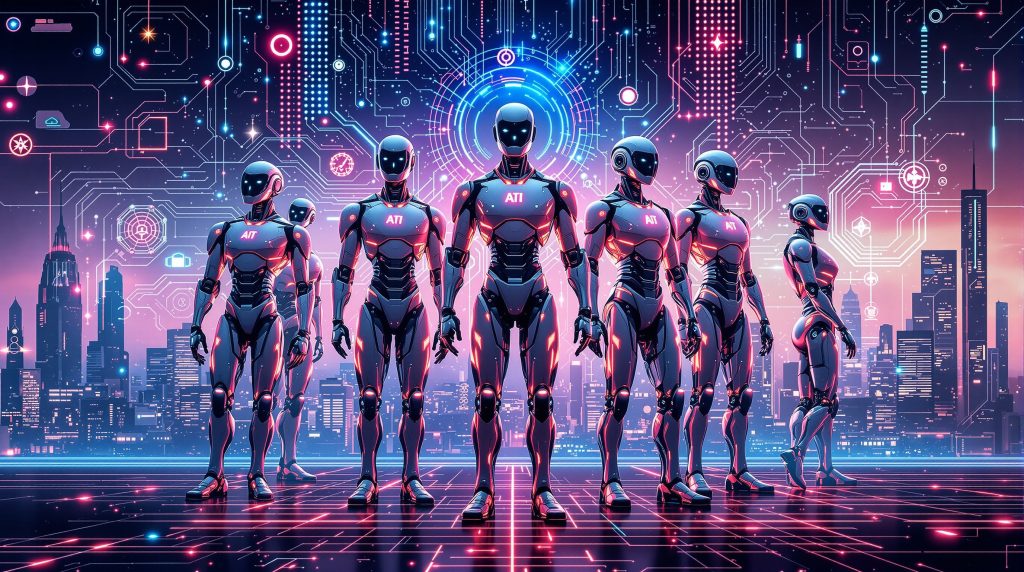
The future is no longer a distant concept confined to science fiction—it’s unfolding before our eyes. As we stand at the precipice of a robotics revolution, the question isn’t whether humanoid robots will integrate into our daily lives, but rather how quickly we can adapt to this transformative reality. From open-source operating systems to emotionally intelligent carebots, the landscape of robotics is evolving at breakneck speed, promising to reshape everything from our homes to our healthcare systems.
🤖 The Foundation: OpenMind’s OM1 OS
Just as Android revolutionized smartphones by providing a unified platform for diverse devices, OpenMind’s OM1 OS is poised to do the same for robotics. This groundbreaking open-source, hardware-agnostic operating system represents more than just technological innovation—it’s the foundation for a standardized robotic future. By streamlining diverse robot functionalities under one umbrella, OM1 OS eliminates the fragmentation that has long plagued the robotics industry. Developers can now focus on creating applications and experiences rather than wrestling with incompatible systems, accelerating innovation across the entire sector.
🌐 The Hive Mind: Global Learning with “Fabric”
Perhaps the most fascinating—and potentially concerning—development is OpenMind’s “Fabric” protocol. This system enables instant knowledge sharing among robots worldwide, creating what essentially amounts to a decentralized hive mind. When one robot learns to fold laundry more efficiently in Tokyo, that knowledge can immediately benefit a household robot in Toronto. While this interconnectedness promises unprecedented efficiency and rapid skill development, it also raises critical questions about data security, privacy, and the potential risks of a globally connected robotic network.
🏠 Welcome Home: The Rise of Humanoid Companions
The concept of household robots is transitioning from fantasy to reality with innovations like Engine AI’s SAO2. Priced at an accessible $5,300, this humanoid companion represents a significant milestone in making advanced robotics available to average consumers. What sets SAO2 apart isn’t just its humanoid form, but its ability to learn from user interactions, creating a truly personalized experience. This adaptive learning capability means the robot becomes more valuable over time, understanding household routines, preferences, and needs with increasing sophistication.
🤗 Emotional Intelligence: The Next Frontier
Healthcare and eldercare are experiencing their own robotic renaissance through innovations like Forier’s GR3 carebot. This isn’t just another mechanical assistant—it’s a robot designed with emotional intelligence at its core. The GR3 can interpret emotional cues, engage in contextual conversations, and provide appropriate physical interactions. In an aging global population where healthcare resources are increasingly strained, emotionally intelligent carebots offer a promising solution that combines practical assistance with genuine companionship.
🇨🇳 China’s Trillion-Dollar Gamble
While individual innovations capture headlines, China’s comprehensive approach to AI integration demonstrates the true scale of this transformation. With a trillion-dollar investment backing their AI strategy, China is creating an interconnected ecosystem that spans factories, hospitals, and homes. This isn’t just about deploying robots—it’s about fundamentally restructuring society around AI-driven systems. The collaboration between financial institutions, academic researchers, and technology companies creates a synergy that could accelerate China’s position as a global leader in practical AI implementation.
Preparing for the Inevitable
The question posed at the beginning—”Are you ready for the future?”—becomes more pressing with each technological breakthrough. The convergence of affordable hardware, intelligent software, and global connectivity is creating a perfect storm for robotic adoption. However, readiness isn’t just about embracing new technology; it’s about addressing the social, economic, and ethical implications of a robot-integrated society.
Workers across industries must consider how robotics will reshape their careers. Families need to think about the implications of AI companions in their homes. Policymakers face the challenge of regulating rapidly evolving technologies while fostering innovation. The healthcare sector must balance the benefits of carebot assistance with the irreplaceable value of human compassion.
The Road Ahead
As we navigate this robotics revolution, the most important realization is that this future is not happening to us—we are actively creating it. Every purchase decision, policy vote, and technological adoption shapes the trajectory of robotic integration. The humanoid companions, emotional carebots, and globally connected robot networks of today are merely the beginning of a transformation that will define the next century.
The robots are coming, not as invaders from science fiction, but as tools, companions, and collaborators that we are designing to enhance human life. The question isn’t whether we’re ready—it’s whether we’re wise enough to shape this revolution in ways that benefit all of humanity. The future of robotics isn’t just about the technology we create; it’s about the society we choose to build around it.