
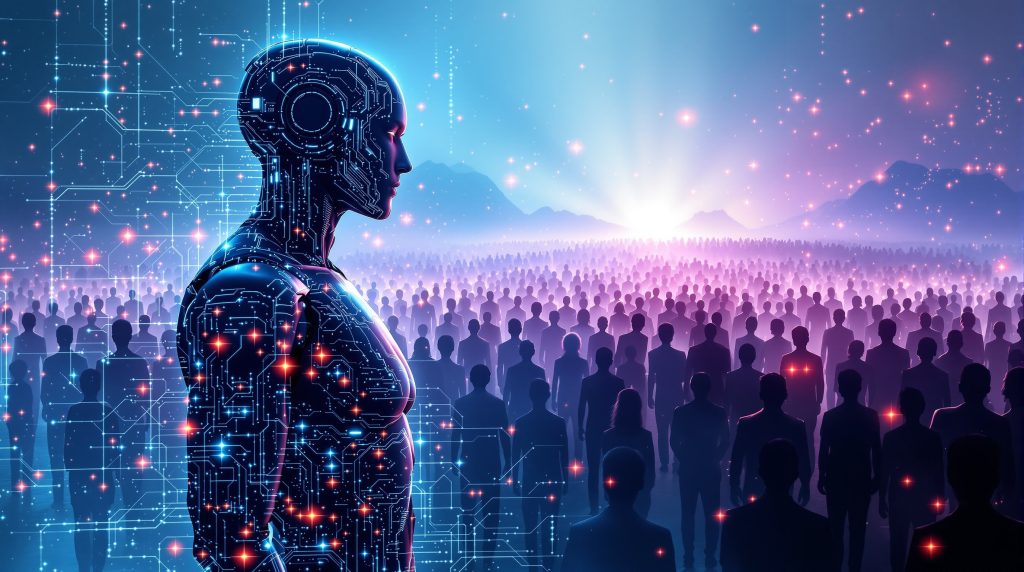
The creative landscape is experiencing a seismic shift as artificial intelligence rapidly advances, sparking intense debate about the future of human creativity. We stand at a fascinating crossroads where AI capabilities are expanding exponentially, yet human creative essence remains distinctly irreplaceable. This intersection promises to reshape how we think about creativity, innovation, and the very nature of artistic expression.
The Dawn of AI-Powered Creative Exploration
Artificial intelligence has emerged as a formidable force in broad conceptual exploration, demonstrating an remarkable ability to traverse vast intellectual territories at unprecedented speeds. Unlike human creators who may be constrained by personal biases, cultural limitations, or cognitive fatigue, AI systems can generate thousands of creative possibilities within minutes, exploring combinations and connections that might never occur to the human mind.
This computational approach to creativity offers several compelling advantages. AI can analyze patterns across enormous datasets, identifying trends and possibilities that span cultures, time periods, and disciplines. It can combine elements from disparate fields—merging musical styles from different continents, blending architectural principles with biological forms, or creating literary works that draw from countless sources simultaneously.
However, this breadth comes with notable limitations. While AI excels at generating quantity and exploring vast possibility spaces, it often lacks the nuanced understanding of human experience that gives creative work its emotional resonance and cultural significance.
The Irreplaceable Human Creative Touch
What distinguishes human creativity goes far beyond mere idea generation. Human creators bring depth, emotional intelligence, and cultural context that transforms raw concepts into meaningful artistic expressions. Our creativity is deeply rooted in lived experience, shaped by personal struggles, cultural heritage, and emotional journeys that AI cannot authentically replicate.
Consider how a human composer might draw from personal heartbreak to create a melody that resonates with millions, or how a visual artist’s understanding of social injustice infuses their work with powerful commentary. These creations carry authentic emotional weight because they emerge from genuine human experience, not algorithmic pattern matching.
Furthermore, humans possess an intuitive sense of what matters to other humans. We understand subtext, cultural references, and emotional subtleties that make creative works truly impactful. This human touch in creativity involves not just producing novel ideas, but crafting them with purpose, meaning, and emotional intelligence.
Navigating the Novelty-Coherence Spectrum
One of the most fascinating aspects of the AI-human creativity comparison lies in balancing novelty with coherence. AI systems can generate wildly imaginative and unexpected combinations, often producing results that surprise even their creators. However, this creative freedom frequently comes at the expense of logical structure, emotional coherence, or practical applicability.
Human creativity, guided by intuition and experience, naturally maintains a more delicate balance. We instinctively understand when an idea is too radical to be effective, when innovation serves the greater purpose, or when familiar elements should anchor novel concepts. This intuitive sense of creative balance allows humans to push boundaries while maintaining accessibility and relevance.
The human creative process also involves iterative refinement—we can sense when something feels “right” or needs adjustment, drawing on emotional intelligence and cultural awareness that current AI systems lack. This refinement process is where many breakthrough creative works truly come to life.
AI as Creative Collaborator, Not Competitor
Rather than viewing AI as a threat to human creativity, forward-thinking creators are embracing it as a powerful collaborative partner. This partnership model leverages the unique strengths of both AI and human intelligence, creating possibilities that neither could achieve alone.
AI excels in the early stages of creative work—brainstorming, generating variations, exploring unexpected combinations, and providing raw material for human refinement. It can serve as an tireless creative assistant, offering endless inspiration and helping overcome creative blocks. Meanwhile, humans contribute strategic vision, emotional depth, cultural sensitivity, and the crucial ability to transform ideas into meaningful experiences.
This collaborative approach is already yielding impressive results across various fields. Musicians use AI to generate melodic ideas while adding human interpretation and emotional expression. Writers employ AI for plot suggestions and character development while crafting the narrative voice and emotional journey. Visual artists leverage AI for initial concepts while applying personal style and meaningful intent.
The Future of Human-AI Creative Synthesis
As AI continues to evolve, the intersection with human creativity will likely become even more sophisticated. We may see AI systems that better understand cultural context, emotional nuance, and human values. Conversely, humans will become more adept at directing AI capabilities toward meaningful creative goals.
The most exciting possibility lies in true creative synthesis—where AI and human creativity combine to produce works that neither could create independently. This could lead to entirely new forms of artistic expression, innovative solutions to complex problems, and creative breakthroughs that push the boundaries of human imagination.
However, this future requires careful consideration of authenticity, originality, and the value we place on human creative expression. As AI capabilities grow, society will need to grapple with questions about authorship, the role of human creativity in an AI-enhanced world, and how to preserve the distinctly human elements that make creative works meaningful.
The intersection of AI and human creativity represents not an endpoint, but a new beginning. By embracing collaboration over competition, we can harness AI’s vast exploratory capabilities while preserving and enhancing the emotional depth, cultural wisdom, and intuitive brilliance that define human creativity. The future belongs not to AI or humans alone, but to the powerful synthesis of both.