
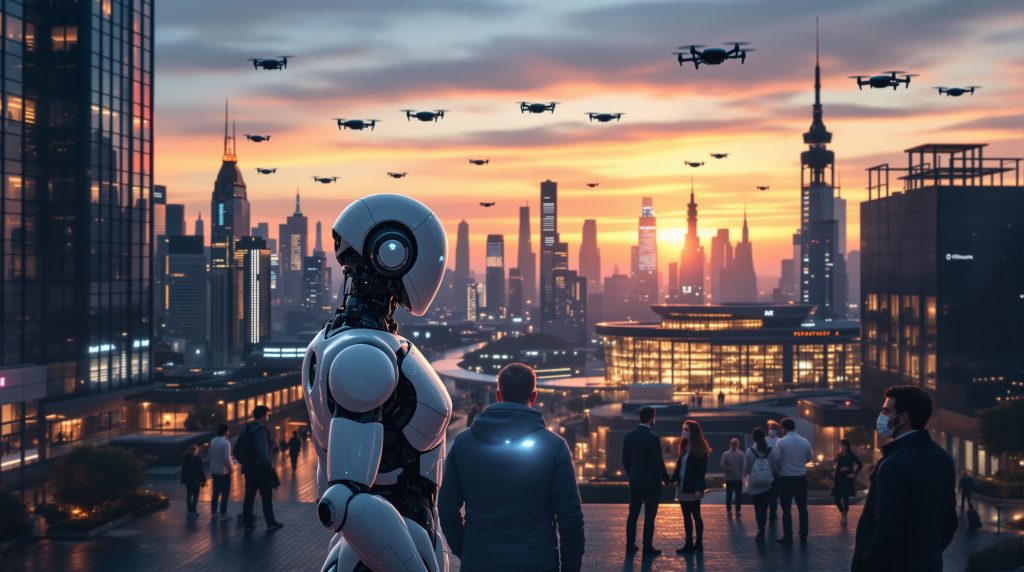
As we close 2025, the convergence of artificial intelligence and robotics has reached a pivotal moment that could very well herald the dawn of the next industrial revolution. The breakthroughs achieved this December represent more than incremental progress—they signal a fundamental shift in how we conceive of automation, manufacturing, and human-machine collaboration.
The Precision Revolution: When Robots Master the Art of Embroidery
Perhaps the most striking development comes from China’s robotic precision capabilities, where humanoid robots have achieved the seemingly impossible: performing intricate embroidery work with remarkable skill. This breakthrough transcends mere technological achievement—it represents a paradigm shift in automation philosophy. For decades, robots have excelled at repetitive, high-force tasks in manufacturing environments. Now, they’re mastering the delicate, nuanced work that has long been considered the exclusive domain of human craftsmanship.
The implications extend far beyond textile arts. If robots can handle the subtle pressure variations, intricate patterns, and adaptive responses required for embroidery, they can potentially revolutionize industries requiring fine motor skills and precision—from surgical procedures to jewelry making, from electronics assembly to food preparation.
The Trinity of Intelligence: Data, AI, and Physics Unite
Tars Robotics’ integration of data, AI, and physics represents a fundamental evolution in robotic intelligence. This “AI Physics Trinity” approach moves beyond traditional programming paradigms, creating systems that can understand and adapt to physical laws in real-time while processing vast amounts of sensory data through advanced AI algorithms.
This integration enables robots to develop what can only be described as intuitive understanding of their environment. Rather than following pre-programmed responses, these systems can predict outcomes, adjust strategies, and learn from failures—much like human workers do when mastering new tasks. The consistency this provides could revolutionize quality control and reduce the variability that has long plagued automated systems.
Breaking Down Barriers: The Human-Robot Interaction Challenge
Figure AI’s Figure 03 model demonstrates significant progress in physical interaction capabilities, yet it also highlights one of the most persistent challenges in robotics: seamless communication. While the robot excels in environments requiring complex physical manipulation, speech latency issues remind us that the path to truly integrated human-robot workplaces still has obstacles to overcome.
However, this challenge shouldn’t overshadow the achievement. Effective physical interaction—understanding spatial relationships, applying appropriate force, and responding to dynamic environments—represents enormous progress toward robots that can work alongside humans rather than simply replacing them in isolated tasks.
Consumer Adoption: The Market Speaks
The commercial success of Unit Dynamics’ Vbot robot dog reveals a crucial factor in any industrial revolution: consumer acceptance. Strong sales figures indicate that the public is ready to embrace robotic companions and assistants, suggesting that resistance to automation may be lower than historically anticipated.
This consumer enthusiasm creates a positive feedback loop—increased adoption drives further investment in research and development, accelerating technological advancement while reducing costs through economies of scale. The transition from industrial curiosity to consumer commodity often marks the tipping point for revolutionary technologies.
The Factory Floor Transformation
Perhaps most indicative of revolutionary change is the deployment of humanoid robots in industrial settings, particularly companies like Xiaomo implementing robotic workers in battery production. This isn’t simply automation—it’s the replacement of human workers with machines that can adapt, learn, and optimize their performance over time.
The choice of battery production is particularly significant, given the critical role of energy storage in everything from electric vehicles to renewable energy systems. As these robots prove their effectiveness in such crucial manufacturing processes, their adoption across other industries becomes inevitable.
The Revolutionary Tipping Point
What makes these developments truly revolutionary isn’t any single breakthrough, but their convergence. Precision capabilities, intelligent adaptability, improved interaction, market acceptance, and industrial implementation are occurring simultaneously, creating a synergistic effect that accelerates progress across all fronts.
Previous industrial revolutions were characterized by single transformative technologies—steam power, electricity, or computerization. The current revolution is defined by the integration of multiple advanced technologies, creating capabilities that exceed the sum of their parts.
Challenges and Considerations
However, revolution brings disruption. The replacement of human workers in factories raises important questions about employment, retraining, and economic inequality. While new jobs will undoubtedly emerge—in robot maintenance, AI training, and human-robot interaction design—the transition period may prove challenging for many workers.
Additionally, the concentration of advanced robotics capabilities in certain regions or companies could create new forms of economic and technological dependency, requiring careful policy consideration to ensure broad benefits from these advances.
Looking Forward: The Shape of Tomorrow
As we stand at this technological inflection point, it’s clear that AI and robotics are indeed powering the next industrial revolution. The question is no longer whether this transformation will occur, but how quickly it will unfold and how successfully society will adapt to the changes it brings.
The developments of December 2025 suggest that the pace of change is accelerating rapidly. Organizations, governments, and individuals must begin preparing now for a future where intelligent robots are not science fiction, but everyday reality. The revolution is not coming—it has already begun.